
Piping Practices
Improper piping and installation cause a great deal of compressed air related problems.
Pipe Sizing
As a general rule, piping should be sized to keep air velocity to the following minimums:
- Compressor Room Piping – 20 Ft/Second
- Plant Distribution Air Mains – 30 Ft/Second
- Drops from Mains to Machinery – 40 Ft/Second
These guidelines assure low pressure drops for all but very long pipe runs, allow moisture to effectively drain at low points, and minimize losses at fittings and junctions.
Approximate velocity as follows:

Where:
V = Velocity of Air in Feet per Second
SCFM = Flow Rate in SCFM
Pg = Line Pressure in PSIG
d = Pipe Size (Inside Diameter) in Inches
Piping Material
Traditionally, steel (sometimes referred to as black iron) and galvanized steel piping have been a common choice for compressed air systems. However, these materials suffer from some significant limitations:
- Moisture and oxygen in compressed air makes rust and corrosion inevitable. This roughens pipe, increasing pressure drop, and eventually constricting the pipe diameter. Leaks could result.
- Installation is labor intensive, and future modification is difficult.
- Typical threaded installation method is prone to leakage
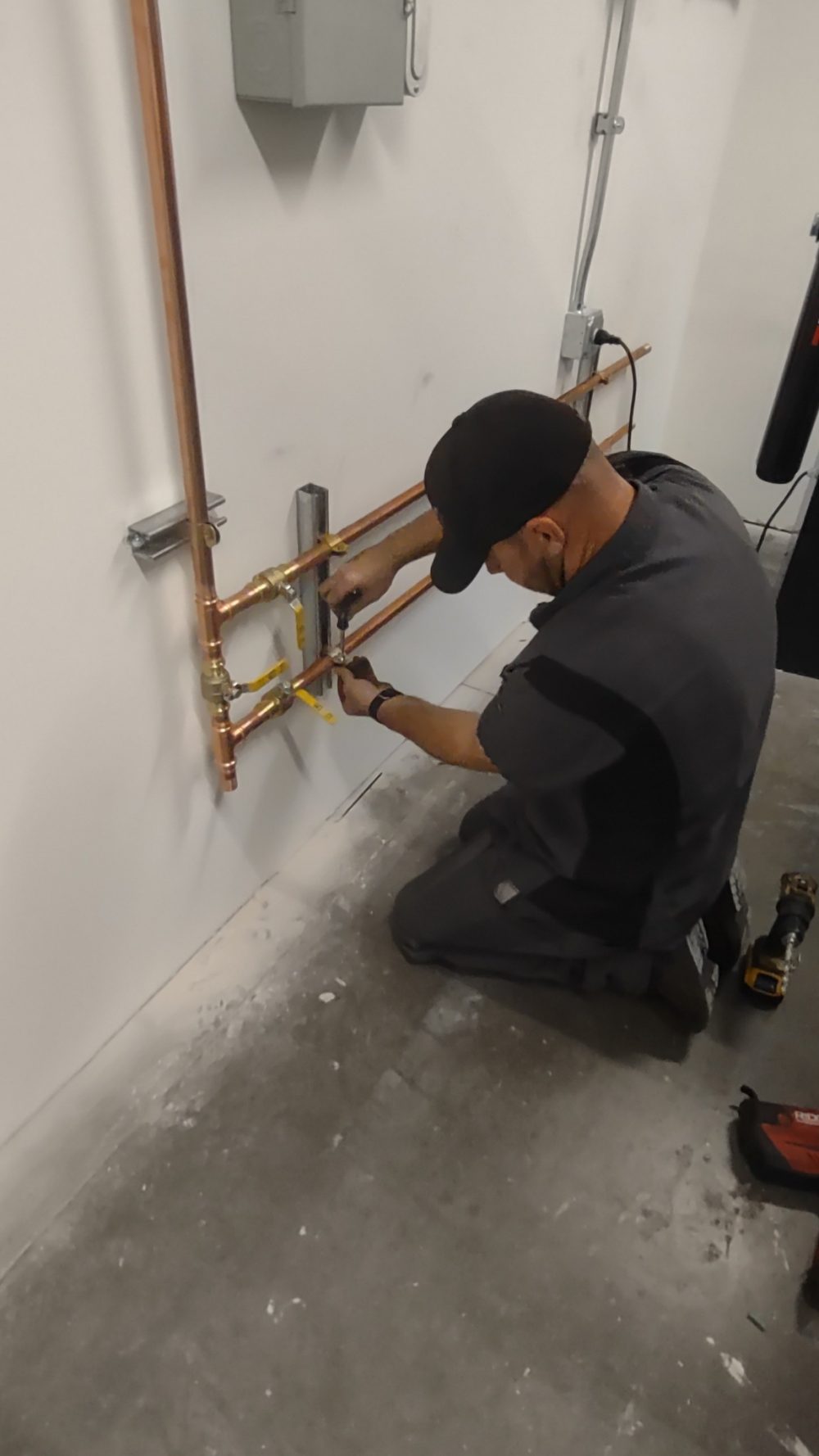
Using brazed copper provides a smooth, leak-free installation that does not corrode in most applications. However, rising copper costs plus required brazing labor make this one of the most expensive installation methods. Soldered (sweated) copper piping is not recommended for compressed air.
Stainless steel is another acceptable, but cost prohibitive, option.
For most plant air systems, the preferred plumbing material has become aluminum alloy piping that is specifically designed for compressed air use. With quick modification ability, easy installation, little additional weight, and lack of corrosion, it is easily the best option.
Most piping materials are now available with mechanical fittings, rather than brazed or threaded connectors. These mechanical methods lock pipe together with grooves, crimps, or retaining teeth. An o-ring or gasket then seals the joint. In many cases, these are acceptable for compressed air, but often require special seals. Be certain to confirm that the piping system is rated for compressed air and it’s likely contaminants (such as compressor oil and water) at the designed operating pressure.
PVC and ABS piping must never be used for compressed air. They become brittle over time, and may explode, posing a significant hazard. Some nylon, polyethylene, and other plastic piping materials are specifically designed for compressed air, but great care must be taken in their installation. They may not meet building code in certain regions.
Pipe Layout
Layout of plant air distribution can have as great a factor on the air system performance as the pipe size, if not more. In some facilities, years of misinformation or ignorance has led to improper piping practices that allow contaminated air to end users and cause elevated pressure drop.
Too often, the solution to a pressure drop problem is to increase compressor pressure. However, this method simply causes higher leak rate and power consumption. The preferable solution would be to properly pipe the system to minimize pressure loss. Some strategies to achieve this are:
- Install the air main piping in a loop or grid, so that there are multiple paths for air to travel to any location. Even in a simple loop, there are two paths for air to get to any user. This halves the flow traveling in each direction around the loop, reducing the pressure drop to ¼ the level in a single trunk line.
- Always use full port valves that do not reduce pipe diameter. Ball valves are preferred, but butterfly valves can be a good choice, as long as the seal materials are compatible with compressed air, moisture, and compressor lubricant.
- Install isolation valves at many locations in the air mains. This allows for small sections shut downs of the main to accommodate expansions, additional drops, or pipe modifications without shutting down the entire air system. This reduces the temptation to split undersized air drops to many machines when requiring an additional drop.
- Pipe drops from the top of the air main. This reduces contamination of tools and machinery in the event of an air treatment failure, as the contamination will remain at the bottom of the pipe.
- Install periodic drip legs from the bottom of the air mains. These should be used only for draining contaminants and/or checking air quality.
- If installing a new the system of non-easily modified material, consider placing a tee and valve at each pipe coupling. Never have outlets more than 10 feet down the air main.